When it comes to renewable energy, one of the big challenges is figuring out how to make solar street lights work reliably. I mean, it’s pretty clear that many of these issues come down to poor design or manufacturing glitches, as John Smith from SolarTech Innovations pointed out—he says a lot of problems are just due to inadequate setup. As more cities and towns start deploying more efficient lighting, it’s really important to understand how to troubleshoot and fix solar street lights when they stop working.
OEM and ODM manufacturing options are super important here. They help improve the design, quality, and performance of these lights. When companies work together and focus on collaboration, they can make sure their products are up to snuff. That’s especially true considering how much we depend on dependable solar street lights in our cities.
But, let’s be honest—not all manufacturing methods are flawless. Sometimes, designs don’t take local conditions into account, which can lead to failures. So, adapting solutions to local needs really does make a difference. Plus, investing in high-quality OEM and ODM options can really cut down on common problems and boost overall performance. In the end, that’s what we need if we want solar street lights to truly make a difference—lighting up our streets effectively and sustainably.

Understanding OEM and ODM Concepts in Solar Street Light Solutions
OEM (Original Equipment Manufacturer) and ODM (Original Design Manufacturer) solutions play a vital role in addressing the challenges faced by solar street light systems. As urban areas adopt solar-powered street lighting, issues such as product performance, design efficiency, and reliability arise. Data from the International Renewable Energy Agency indicates that the solar street light market is projected to reach USD 8.2 billion by 2025. However, there is a notable gap in quality and innovation across different products in the market.
OEMs focus on manufacturing existing designs. This approach ensures standardized quality control for solar street lights. They often collaborate with established brands to maintain a specific performance level. ODMs, on the other hand, create tailored designs to meet unique local demands. This flexibility can help overcome some of the current pitfalls in street light implementations, such as battery failures or inefficient solar panels. In contrast, not all ODMs may fully grasp the technical intricacies of solar technology, leading to inconsistent performance.
Reports show that 25% of solar street light projects fail due to improper installation or design flaws. Both OEM and ODM partnerships can mitigate these risks by prioritizing quality testing and iterative design improvements. The collaboration results in innovative solutions that truly address the unique environmental and infrastructural needs of diverse urban areas. The integration of robust OEM and ODM practices can enhance the overall reliability of solar street lights in numerous ways.
Identifying Common Issues in Current Solar Street Light Designs
When discussing solar street light designs, several common issues arise. One major problem is inadequate battery life. Many systems fail to perform optimally during cloudy days. This can result in lights shutting off earlier than expected. Another issue is sensor malfunction. Incorrect readings may lead to lights being turned on or off unnecessarily.
To address these challenges, OEM and ODM solutions provide customization options. These solutions allow manufacturers to create tailored products that better meet user needs. For example, integrating higher-capacity batteries can improve performance and reliability.
Tips: Always check the solar panel quality. Well-made panels capture more energy. Consider using motion sensors wisely. They can conserve energy but might require fine-tuning. Regular maintenance can significantly extend the life of the system. Overlooking this can lead to premature failures.
The Role of OEM and ODM in Addressing Solar Street Light Challenges
OEM and ODM solutions play a crucial role in tackling the challenges faced by solar street light systems. Many municipalities struggle with these products' efficiency and longevity. According to a report by the International Energy Agency, nearly 70% of solar lighting projects falter due to subpar components. OEM (Original Equipment Manufacturer) and ODM (Original Design Manufacturer) partnerships can bridge this gap effectively.
These manufacturing solutions provide customized, quality components tailored to the unique needs of solar street light applications. For instance, a specialized battery or LED design can enhance system performance significantly. When cities opt for high-quality OEM components, they often see a reduction in failure rates, ensuring a more dependable solar street light solution. The World Bank estimates that well-designed solar street lighting systems can improve public safety and reduce crime rates by up to 30%.
However, not all collaborations yield positive results. Some companies may prioritize cost over quality, leading to unreliable products. These challenges highlight the importance of careful selection in OEM and ODM partnerships. Ensuring that manufacturers adhere to strict quality standards is essential for long-term success. A commitment to quality can lead to effective solar street light installations that truly serve their communities.
Why OEM ODM Solutions Are Key to Fixing Solar Street Light Issues
| Challenge |
OEM Solution |
ODM Solution |
Impact |
| Battery Efficiency |
Collaborating with specialized battery manufacturers to enhance performance |
Designing integrated systems that optimize power management |
Increased operational time and reduced maintenance frequency |
| Light Output Quality |
Sourcing high-quality LED components for better illumination |
Creating custom light distribution optics tailored to urban environments |
Enhanced visibility and user satisfaction |
| Durability |
Partnering with robust material suppliers for housing |
Engineering designs that withstand environmental challenges |
Longer lifespan of fixtures and reduced replacement costs |
| Installation Complexity |
Providing standard installation kits and manuals |
Customizing solutions for easy integration with existing infrastructure |
Faster deployment and lower labor costs |
| Cost Effectiveness |
Optimizing supply chain and bulk purchasing |
Offering value-engineered solutions to maximize budget use |
Improved ROI for municipal projects |
Advantages of Customized Solutions in Solar Street Light Manufacturing
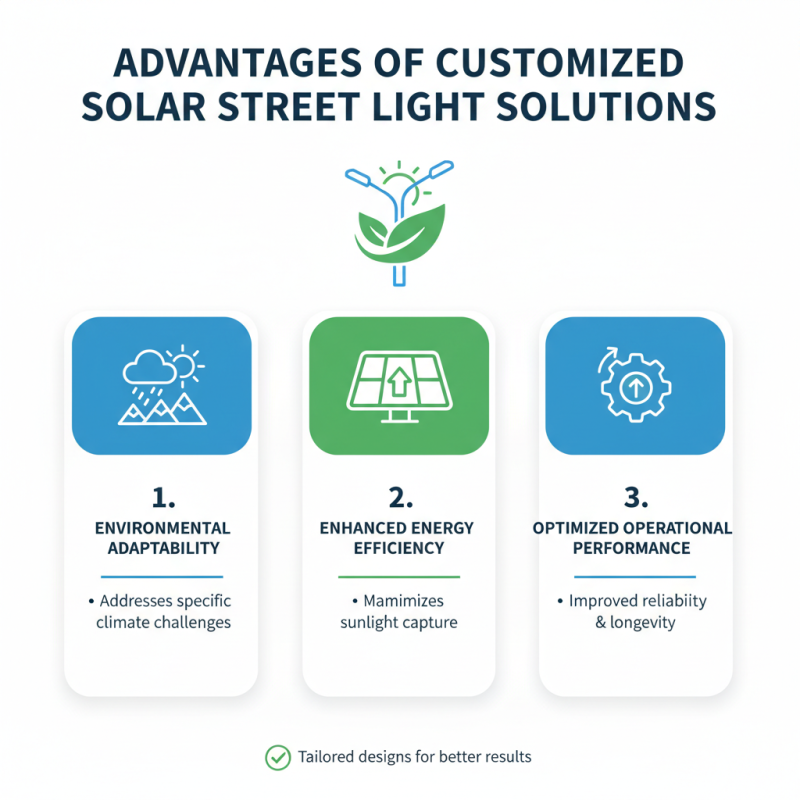
Customized solutions in the solar street light manufacturing sector offer significant benefits. Tailored designs can address specific environmental challenges. For instance, integrating solar panels that maximize sunlight capture enhances energy efficiency. This adaptability plays a crucial role in optimizing operational performance.
Another advantage lies in the material selection for Street Light Solar Light. Manufacturers can choose durable components that withstand extreme weather. This ensures longevity and reduces maintenance costs. However, achieving the perfect balance between cost and quality remains a challenge. Some manufacturers may compromise on materials to cut expenses, leading to potential failures.
Collaboration with experienced manufacturers enhances the design process. These experts bring insights into local regulations and environmental factors. Yet, communication gaps may occur, hindering effective project execution. Producers often overlook the importance of feedback loops. Addressing these issues ensures a more reliable final product that truly meets community needs.
Case Studies: Successful Implementations of OEM and ODM in Solar Lights
Successful implementations of OEM and ODM in solar lighting have proven crucial. Many communities have benefitted from tailored solutions. For instance, a city implemented an ODM approach to create solar street lights that adapt to varying climate conditions. This flexibility increased the lights' longevity and performance.
Importantly, these solutions allow for customization over costs and functionalities. For example, cities can choose energy-efficient LEDs, smart sensors, or solar panel orientations based on specific needs. Such adjustments can enhance efficiency while minimizing maintenance issues. However, some projects revealed challenges with integration and local infrastructure.
Tips: Engage with local stakeholders during the planning phase. This approach ensures the new technology fits the existing systems well. Regular feedback is essential to refine these adaptations. A proactive mindset can often prevent future issues and ensure smooth implementation. Building a community awareness program can also help in educating users about operational nuances.
Future Trends in OEM and ODM for Improved Solar Street Light Performance
The future of solar street lights relies heavily on OEM and ODM solutions. These approaches offer manufacturers a way to innovate and improve product design. Yet, not every solution fits seamlessly into existing systems. Understanding the unique needs of each environment is crucial for success.
Recent trends indicate a shift toward customizable components. This allows for better adaptability in solar street light applications. However, many companies still struggle with standardized options. Customization requires collaboration between designers and engineers. This partnership can lead to groundbreaking innovations. But communication gaps often hinder progress.
Moreover, incorporating smart technologies is becoming essential. Smart sensors and connectivity enhance functionality. Yet, the cost and complexity of integration can be daunting. Companies must weigh the benefits against potential risks. Regular feedback from end users can guide improvements, but achieving this can be challenging. The balance between innovation, reliability, and cost remains delicate. Manufacturers must navigate these waters carefully to optimize performance.
Performance Improvement of Solar Street Lights Using OEM and ODM Solutions
Evaluating the Impact of OEM and ODM on Solar Street Light Sustainability
When considering solar street light sustainability, OEM and ODM solutions play a vital role. They allow manufacturers to tailor products to specific needs. With varied environments and requirements, flexibility is crucial. Customization can enhance efficiency and longevity. These solutions enable innovation, addressing challenges faced by standard products.
However, the reliance on customization raises questions. Is there a standard for quality? OEM and ODM relationships may lead to inconsistencies. Some manufacturers prioritize cost over durability. This could impact the lifespan of Led Light Solar Street Light. A poorly designed product may not withstand harsh weather. It’s essential for stakeholders to monitor standards and performance rigorously.
Investing in OEM and ODM involves risk but offers substantial benefits. By fostering collaboration, communities can develop solar street lights that meet local needs. Design improvements can lead to increased sustainability. Shared knowledge can create a more resilient infrastructure. Yet, manufacturers should remain vigilant about maintaining quality amidst challenges.
Innovative and Energy-Efficient: The New Design LED Street Light Series (50W to 240W) for Smart Urban Lighting Solutions
The new LED street light series, designed with a wattage range from 50W to 240W, exemplifies innovative and energy-efficient urban lighting solutions. This series operates with an input voltage of AC100V-277V, making it versatile for various urban environments. With an impressive lumen efficiency of 140-180lm/W, these lights considerably enhance urban illumination by maximizing energy use while minimizing operational costs. According to industry reports, such efficiency can lead to energy savings of up to 50% compared to traditional street lighting solutions, making a substantial impact on municipal budgets and energy consumption.
The design features a flat honeycomb structure constructed from die-casting aluminum and tempered glass, which ensures excellent heat dissipation and longevity. This robust design is further enhanced by a professional glare-free lens available in various beam angles (60°, 90°, 120°, T2, T3, T4), allowing for customizable lighting solutions that cater to specific street configurations and user needs. Moreover, the integration of advanced control options, such as 0-10V dimming, time control, light sensors, and IoT integration, signifies a leap towards smart urban lighting. The adaptability of the mounting angle (90°/180° with ±15° adjustment) allows for easy installation and optimal lighting direction, fulfilling diverse urban requirements while maintaining user safety and comfort.
With an IP65 rating and a five-year warranty, this new LED street light series ensures durability and resilience in various weather conditions. The tool-free disassembly feature facilitates effortless maintenance, promoting sustainability in urban settings. As cities strive towards smarter, greener infrastructures, this innovative lighting series addresses crucial energy efficiency and adaptability challenges, setting a benchmark for the future of urban lighting solutions.
FAQS
: Inadequate battery life is a frequent problem. Lights may shut off early, especially on cloudy days.
Incorrect sensor readings can cause lights to turn on or off unnecessarily, impacting their effectiveness.
They offer customization options to improve performance. Tailored components can address specific user needs.
Regular maintenance is critical. Overlooking this can lead to premature failures and reduced efficiency.
Tailored designs enhance energy efficiency. They can adapt to environmental challenges for better performance.
Durable components are essential. They must withstand extreme weather to ensure longevity and decrease maintenance needs.
Compromising on materials can lead to unreliable products. This can result in performance failures and user dissatisfaction.
They provide valuable insights into regulations and environmental factors. Yet, communication gaps may hinder successful execution.
Feedback loops are crucial for refining designs. Ignoring them may result in products that do not meet community needs.
Effective systems can reduce crime rates by up to 30%. They enhance public safety and overall community wellbeing.
Conclusion
The article "Why OEM ODM Solutions Are Key to Fixing Solar Street Light Issues?" explores the significance of Original Equipment Manufacturer (OEM) and Original Design Manufacturer (ODM) solutions in enhancing the efficiency and performance of solar street lights. It begins by clarifying the concepts of OEM and ODM in the context of solar technology, followed by an examination of prevalent issues within existing solar street light designs, such as inadequate performance and reliability. The piece emphasizes how OEM and ODM partnerships can effectively address these challenges through customization and innovative design.
Furthermore, the article presents the advantages of tailored solutions in solar street light manufacturing, illustrated by successful case studies that highlight improved functionality and sustainability. It also discusses future trends in OEM and ODM that aim to further elevate solar street light performance. Ultimately, the article serves as a guide on "How To Fix Solar Street Light Not Working" by advocating for the exploration of OEM and ODM methodologies to ensure longevity and effectiveness in solar street lighting systems.